Farma2Go turned one image and a handful of details into a verified Product Truth, a complete PDP and five localised ecommerce product pages in around two hours. The Portuguese page reached Google’s Top 3 for a transactional search related to buying solar eclipse glasses from a pharmacy. This is the full process.
AI product content case study: the key figures
- 23 July, 17:40: Farma2Go sends an image and asks us to create the product page.
- 23 July, around 19:40: five international versions are already being published to Shopify.
- 5 markets: Portugal, France, Italy, Germany and the United Kingdom.
- 1 Product Truth: research, cross-checking and verifiable sources.
- 0 subsequent manual rewrites of the Portuguese PDP before it started gaining organic traction.
- Google Portugal Top 3: an average position of 2.34 for óculos eclipse solar farmácia in the 4 August snapshot.
- 4,116 units sold, 1,341 buyers and €11,652.99 in net sales by 9 August.
It started with one image and a request from Farma2Go
At 17:40 on 23 July 2026, Jorge Peláez, founder of Farma2Go, sent us a WhatsApp image of glasses designed for viewing the 12 August solar eclipse.
The request was simple: create a product page and put the item on sale as quickly as possible.
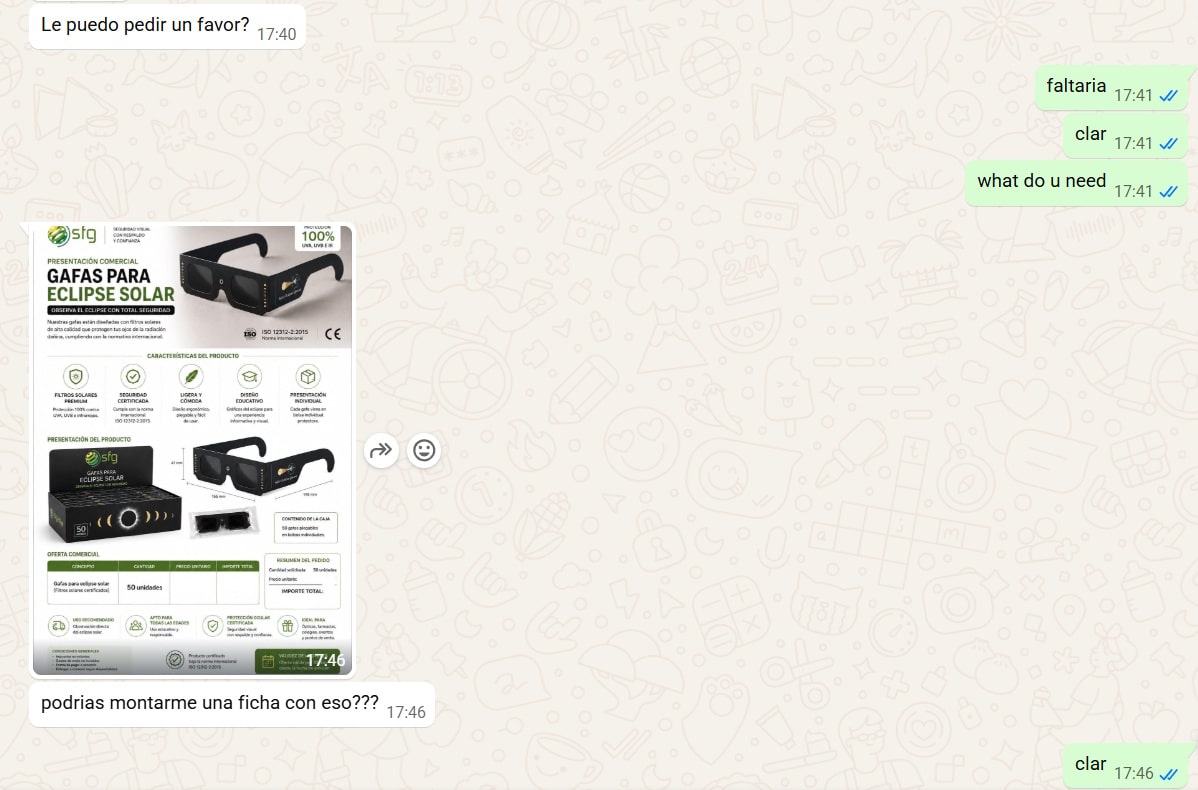
There was no complete PDP, structured ecommerce description, SEO metadata, FAQ section or international content. We had a photograph, a few technical details and very little time.
Before generating any copy, however, we had to solve a more important problem: we needed to establish exactly what the product was and which claims the available evidence supported.
AI product descriptions need a reliable Product Truth
Farma2Go already uses OnCatalog to generate, enrich and localise product content at scale. The principle is straightforward: build a reliable source of product information first, then scale the content.
AI should not invent product information. It should scale from a reliable Product Truth.
In a typical workflow, OnCatalog starts with identifiers such as an EAN and product name. It uses manufacturer documentation, brand information, official product and ingredient sources and other reliable evidence when required.
Only then does it generate each field. Keeping product research separate from AI content generation prevents automation from turning incomplete information into inaccurate content at scale.
From a photo to Product Truth: the research stage
The starting point for the eclipse glasses was unusually limited. Assumptions were not acceptable: the product was intended for direct observation of the Sun and its documentation referred to ISO 12312-2:2015.
Before writing the page, we investigated and cross-checked:
- which specifications genuinely applied to the product;
- which technical documents were available;
- what the reference to ISO 12312-2:2015 meant;
- which claims about the filter were supportable;
- how the glasses should be used;
- which warnings and precautions were required;
- which uses had to be ruled out;
- and which information could not be stated without sufficient evidence.
AI accelerated analysis, comparison and structuring, but the workflow was not photo → prompt → description.
It was: photo → research → verification → Product Truth → product page.
How we created the ecommerce product page
Once the Product Truth was ready, we generated the Spanish master PDP: title, above-the-fold copy, benefits and features, long description, instructions, warnings, FAQs, meta title and meta description.
Research and human oversight were essential up to this point. The next stage turned a single verified source into international product content.
Product content automation: five markets in around two hours
Around two hours after Farma2Go’s first message, the product entered OnCatalog’s international workflow. The same Product Truth generated localised pages for Portugal, France, Italy, Germany and the UK.
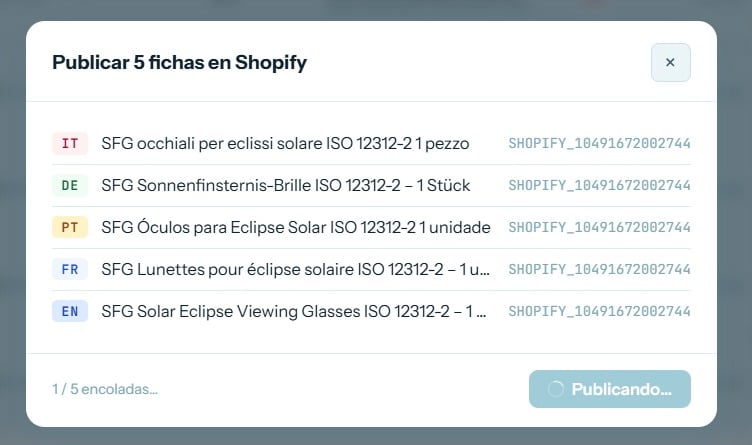
The result was more than five fast translations. In about two hours, largely unstructured input became a researched product, a reliable Product Truth, a complete PDP and five market-ready product pages.
AI ecommerce localisation without a manual rewrite in Portugal
The Portuguese version is particularly significant. The PDP that later started ranking in Google was the original localisation generated by OnCatalog.
Before the organic growth described here, it had not been rewritten by a Portuguese translator, manually adapted by a copywriter or specifically re-optimised to achieve those positions.
The following day: local content to support each market
On 24 July, we also prepared local eclipse content to support the pages through informational searches and create a local content → internal link → PDP journey.
We later found that several international articles had not been published correctly in their target language, so their contribution to the initial growth was limited. That makes the Portuguese result more revealing: the PDP gained traction largely on its own.
International SEO: Google Portugal started ranking the PDP
Over the next few days, the Portuguese page gained organic visibility quickly. A Google Search Console export taken on 9 August, with data processed up to 7 August, showed 4,142 organic clicks, 62,161 impressions, a 6.66% CTR and an average position of 8.03.
During that period, it became the most-clicked organic URL across the entire Farma2Go domain.
An AI-generated product page reached Google Portugal’s Top 3
One of the leading queries was óculos eclipse solar farmácia. In the 4 August Search Console snapshot, Farma2Go held an average position of 2.34: Top 3 for a search with clear commercial intent.
In the 9 August export, after Google had expanded impressions substantially, the query had generated 1,511 clicks, 14,351 impressions, a 10.53% CTR and an average position of 5.45. It was Farma2Go’s second most-clicked query, behind only the brand search.
What search intent was the page capturing?
The variants óculos eclipse solar farmácia, óculos eclipse solar farmacia, oculos eclipse solar, farmacia oculos eclipse and oculos eclipse solar farmacia followed the same pattern.
Google had found a match between product + solar eclipse + pharmacy. People were looking for the glasses and, in many cases, a pharmacy where they could buy them.
The ecommerce result: 4,116 units sold
The Shopify commercial snapshot from 9 August showed:
- 4,116 units sold;
- 1,341 buyers;
- €11,652.99 in net sales.
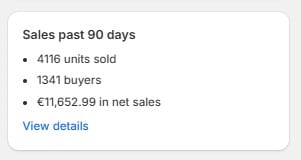
The average was approximately 3.07 units per buyer, consistent with a product that couples, families or small groups may buy together.
The 4,116 units are the product’s total commercial performance. Search Console clearly identifies Portugal as the market where the PDP achieved its strongest organic growth.
Why did the same AI product content perform differently across markets?
The same Product Truth fed each page. The ecommerce infrastructure, generation and localisation system were identical, and publication happened at roughly the same time. Market response was very different.
Portugal quickly found transactional intent
The combination of solar eclipse glasses and pharmacy matched Farma2Go’s offer directly: Google → PDP → purchase.
Demand in Spain was more fragmented
Visibility was split between a Cantabria article, the collection, the national article and the PDP. The Spanish product page recorded 76 clicks and 8,168 impressions.
Italy was beginning to gain visibility
The Italian PDP recorded 303 clicks and 14,703 impressions.
France, Germany and the UK had not found the same pattern
Within the period analysed, those pages had not achieved comparable organic traction.
Preparing several markets quickly does not guarantee the same result in each one. It gives every market the opportunity to reveal where real demand exists.
Ecommerce localisation also became a market discovery tool
Companies traditionally decide where to sell first and then invest in localising their ecommerce content. Product page automation can also reverse that sequence.
When the cost and time required to prepare several markets fall far enough, a company can make the product ready to compete internationally and observe where demand appears.
On 23 July, nobody knew Portugal would stand out. The data revealed it afterwards.
What this case proves about AI product descriptions
It does not prove that any AI-generated product page will rank in Google, or that automated localisation will produce thousands of sales.
It demonstrates something more specific: combining product research, verified sources, Product Truth, AI content generation, catalogue automation, ecommerce localisation, Shopify publishing and international SEO can dramatically reduce the time needed to compete in several markets.
photo → research → Product Truth → PDP → 5 markets → Google Portugal → Top 3 → organic traffic → sales
AI does not replace Product Truth: it scales it
Generating thousands of product descriptions with AI is relatively easy. Generating thousands from incorrect product information is equally easy.
The value lies in building a reliable source first and using automation to scale it. In this exceptional case, we moved from one photograph to five markets in around two hours.
The complete Farma2Go case study timeline
23 July · 17:40
Farma2Go sends the photograph and requests the product page.
23 July · 17:40–19:40
Research, verification, Product Truth construction and creation of the master PDP.
23 July · around 19:40
Five localised product pages are being published to Shopify.
24 July
Local supporting content is prepared for each market.
4 August
óculos eclipse solar farmácia records an average Google position of 2.34.
9 August
The product reaches 4,116 units sold, 1,341 buyers and €11,652.99 in net sales.
Frequently asked questions about AI product descriptions
What is Product Truth?
It is a structured source of verifiable product information, built before content generation. It can feed titles, descriptions, benefits, instructions, metadata, FAQs and localised versions.
Can AI create product pages from an image?
An image can be a starting point, but it should not be the only source when essential information is missing. Here, research and documentation completed the initial evidence.
What is the difference between generating a description and enriching a catalogue?
Text generation is only one stage. Catalogue enrichment identifies the product, gathers reliable information, structures attributes and turns the data into reusable content.
Was the Portuguese page reviewed by a human?
The localisation that started generating the traction described here was OnCatalog’s original output. It was not manually rewritten before it began to rank.
Did the PDP reach Google’s Top 3?
Yes. In the 4 August 2026 Search Console snapshot, óculos eclipse solar farmácia held an average position of 2.34.
Were all 4,116 units sold in Portugal?
No. The figure is the product’s total Shopify performance as of 9 August. Portugal is the market where Search Console shows the strongest organic PDP traction.
What role does international SEO play?
It adapts titles, content and semantics to the way people search in each market. Here, Google connected the Portuguese PDP with high-intent searches for eclipse glasses and pharmacies.
AI product content generation and ecommerce localisation
Scaling an international catalogue requires reliable data, clear structure and content tailored to each market. Ontranslation combines AI product descriptions and localisation, content SEO/GEO and linguistic quality control according to project risk and scale.
See the evidence: view the Portuguese PDP featured in this case study.
More ecommerce, AI and product content case studies
See how we helped Chachifarma scale product content without losing its brand voice, or browse all Ontranslation case studies.
To understand the platform behind this workflow, discover OnCatalog.