There is a familiar moment in international ecommerce: you are already selling on Amazon, you can see that your products work abroad, and it feels as though half the job is done.
You do have valuable evidence. You know there is demand, which products attract buyers and which markets are worth exploring. But moving from Amazon to your own Shopify store changes the rules. Amazon provides a familiar buying environment. On Shopify, your brand must create that trust itself.
This is where many stores go wrong. They translate the catalogue, enable several languages and expect each market to respond in the same way.
FISURA took a more deliberate route.
The project combined ecommerce translation and localisation, Shopify implementation, multilingual SEO and a cost-effective use of AI that did not compromise the brand.
The starting point: a distinctive brand with international demand
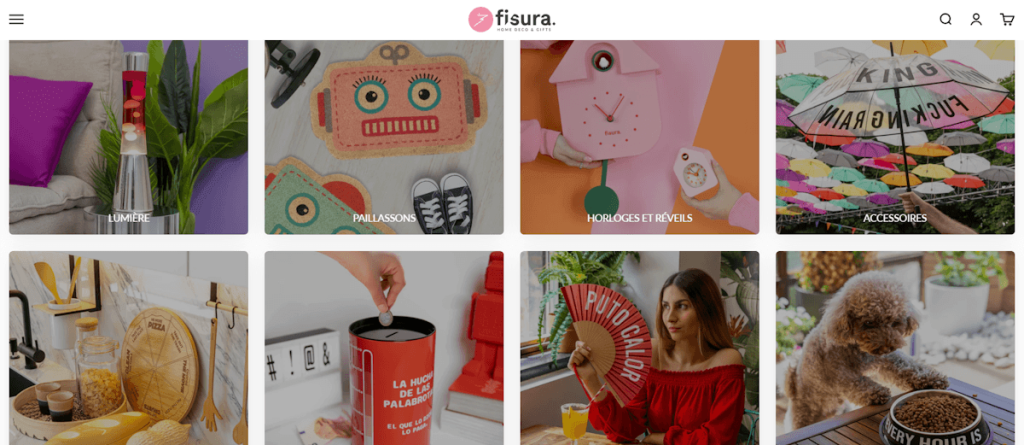
FISURA is a Spanish gifts, homeware and décor brand built around colour, humour and attitude. Its products are designed to live with people, raise a smile and add personality to everyday spaces.
That distinctive voice was both an advantage and a localisation challenge.
In Spain, FISURA can be direct, playful and highly expressive. Its copy uses bold phrases, wordplay, exclamation marks and emojis. Yet a brand with this much personality cannot enter Germany, Italy and France by translating its Spanish voice word for word.
A joke does not travel on its own. Neither does an emoji. Copy that feels fresh in Spanish may sound childish elsewhere. A restrained description may work in Germany while removing much of the appeal in Italy. Literal translation can make a strong brand look poorly translated.
FISURA already had useful commercial evidence: Germany, Italy and France were its strongest Amazon markets. That informed the rollout order—Germany first, followed by Italy and France—and gave Ontranslation a sound basis for planning the international Shopify store.
The practical question was not simply “How do we translate the shop?” It was: what does each market need to understand the product, trust the brand and buy without losing what makes FISURA distinctive?
From Amazon to Shopify: validated demand is not the same as a trusted brand
Amazon had already shown that FISURA’s products could sell internationally, especially in Germany. But Amazon and Shopify operate differently.
- Amazon supplies purchase intent, comparisons, reviews and platform trust.
- Shopify requires the brand to build the context: tone of voice, navigation, product pages, collections and reassurance content.
- A direct channel gives the brand greater control over margin, customer data and the relationship after purchase.
The job was therefore much broader than transferring products into three languages. FISURA needed a multilingual store that could sell on its own terms, supported by a market-specific international ecommerce strategy.
A tiered content model: different content needs different levels of intervention
The core decision was to assign the right production method to each market and content type.
Ecommerce contains high-volume, repeatable content such as product and collection pages. It also contains pages where brand, trust and friction matter more: the homepage, customer information, support content and key campaign messages.
Using the same method for everything is simple, but rarely efficient.
Human translation for every field can make a large catalogue unnecessarily expensive. Fully automating every field may reduce production costs while weakening tone, trust or conversion. The sensible approach is to match the level of human intervention to the commercial impact.
For FISURA, product and collection copy was produced with AI across all three markets, supported by a detailed brief, market-specific prompts, review and quality control. This was the largest and most repeatable part of the catalogue, making it suitable for scalable production.
Other content was handled according to its function and market. Some pages required human translation, some post-editing and others a focused review. The choice was driven by user expectations, the role of each asset and expected return.
| Content type | Approach | Why |
| Products | AI with briefing, tailored prompts and review | High volume, repeatable structure and direct conversion impact |
| Collections | AI with SEO localisation and review | Navigation, search intent and product discovery |
| Homepage | Human translation or post-editing by market | High brand impact and first impression |
| Information pages and footer | Human translation, post-editing or review | Trust, clarity and user expectations |
| Metadata, URLs and Shopify fields | SEO and technical localisation | Organic visibility and store consistency |
The aim was to invest intelligently: raise the level of intervention where it changed trust or conversion, and use scalable production where volume made it valuable.
The localisation brief: turning brand strategy into usable instructions
Before production began, we defined how FISURA should sound in each market and what every part of the store needed to achieve. This went beyond a conventional kick-off call. It converted the brand strategy into concrete production criteria:
- Which elements of the tone should remain and which should be moderated.
- How much humour each market could carry naturally.
- When emojis supported the message and when they should be reduced.
- What German, Italian and French buyers expected to find before purchasing.
- Which content required greater human involvement.
- Which Shopify fields affected SEO, navigation or conversion.
Without this work, the store might have been accurate but flat. Accuracy alone does not preserve desire or brand recognition.
The high catalogue volume required AI-assisted production in every market. The important point was not to reuse one generic prompt: each language needed its own instructions, based on local commercial and cultural expectations.
A real product example: the “Puto calor” fan
One of FISURA’s bestsellers shows how those decisions worked in practice.
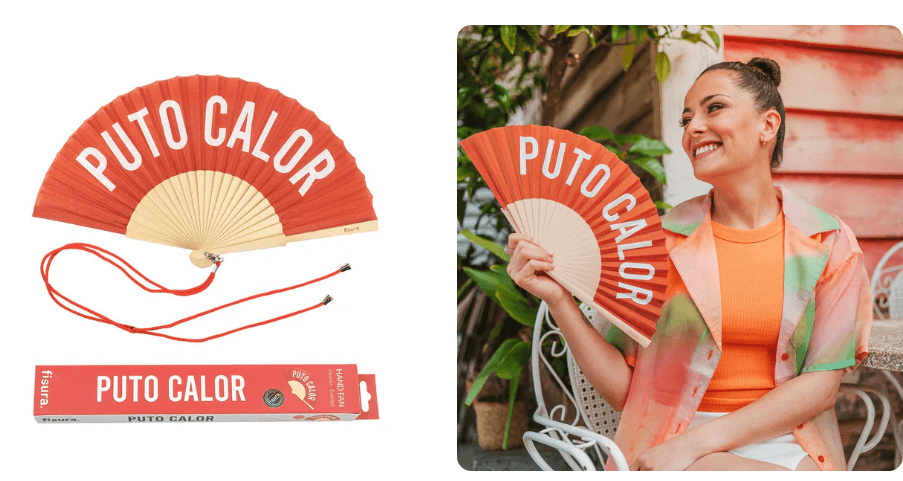
The product name could not be translated because “Puto calor” is printed on the fan itself. The localisation decision concerned the product description and the role it should play in each country.
In Spanish, the copy pushes FISURA’s irreverent voice to its fullest. It evokes sleepless nights, melting ice cream and mosquitoes, with an exaggerated complaint about unbearable summer heat.
In German, the print remains but the copy becomes more functional. It explains how the fan is used, adds practical details and gives greater weight to sustainable materials. The joke survives inside a clearer information structure.
In Italian, the description leans towards sharing and gifting. It keeps the idea of the fan as an essential weapon against hot summer days while adding warmth, utility and a sense of complicity.
In French, the balance is more nuanced. Some variants can remain close to the Spanish energy; others work better when framed around gifting and use occasions such as the beach, a terrace or a summer visit.
The product and technology were the same. The direction given to the content changed: more irreverent in Spanish, more functional in German, more relational in Italian and more balanced in French.
That is the value of a strong brief. The decision is not whether to translate two printed words. It is what the surrounding product copy must do in each market: explain, reassure, entertain, inspire a gift or preserve the brand’s energy.
One brand, three market expectations
The fan illustrates the wider content strategy:
- In Germany, copy needed to strengthen clarity, utility and trust. Decorative products benefited from precise information about dimensions, lighting, use and realistic expectations.
- In Italy, copy could place more emphasis on colour, atmosphere, desire and gifting occasions.
- In France, FISURA’s originality needed a slightly more controlled voice: playful when natural, stylish and specific throughout.
The brand remained consistent. The content strategy adapted.
Multilingual SEO: translating a keyword is not keyword research
Search intent changes by language, market and stage of purchase. A category such as “original gifts” may have obvious linguistic equivalents, but buyers can search by product type, recipient, occasion, style or problem.
Product pages, collections, titles, descriptions and URLs therefore had to reflect how each local audience searched—not simply mirror the Spanish terms. They also needed enough specific information for search engines and generative systems to understand the product, its purpose and the intended audience.
Overly creative copy can lose context. Overly technical copy can lose the brand. The right balance combines clear entities and useful structure with a recognisable voice.
Shopify implementation: where localisation succeeds or fails
The final stage was technical implementation in Shopify.
Store content lives in specific fields: product titles, descriptions, collections, variants, tags, SEO titles, meta descriptions, URLs, page modules and reassurance copy. Each field has a purpose. A well-translated string in the wrong field—or an untranslated technical field—can weaken navigation, SEO and conversion.
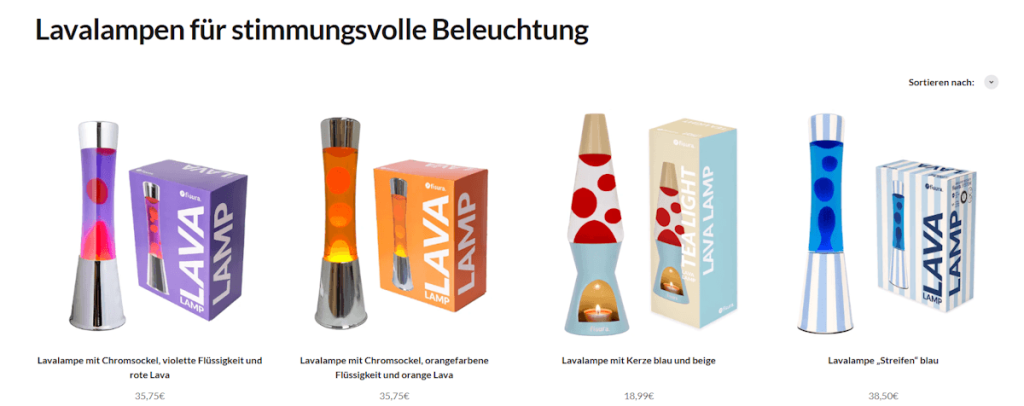
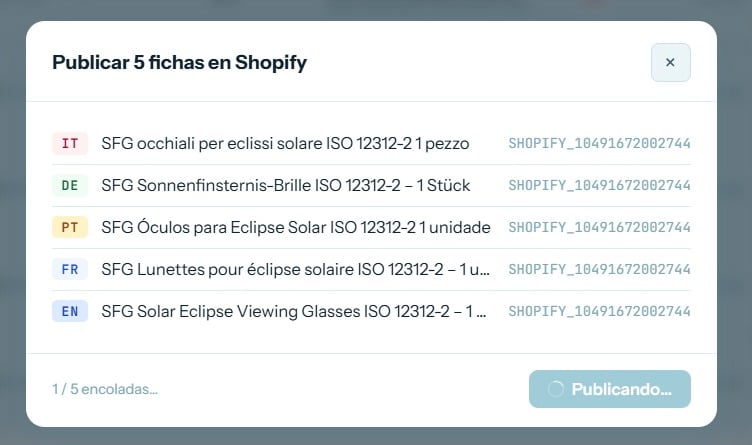
That is why publishing was part of the project. The localisation finished when the store was live with a coherent structure, ready to attract traffic and sell.
The result: international sales from day one
FISURA began making sales in the new markets from the first day.
This was not a universal promise or a linguistic trick. It was the result of combining existing Amazon demand signals, a distinctive product range, a well-planned direct channel and a multilingual execution designed around each market.
High-volume content was produced efficiently. Human attention increased where trust and brand carried more weight. The team adjusted clarity, emotion and detail according to local expectations. That balance made the rollout scalable and commercially viable.
What the FISURA ecommerce case study shows
FISURA’s multilingual Shopify launch shows that international ecommerce starts before translation. It starts with market evidence, channel strategy and a brief that turns brand personality into production criteria.
The project connected:
- Market priorities based on FISURA’s strongest Amazon countries.
- An international Shopify strategy.
- Market-specific positioning.
- A tiered mix of AI production, human translation, post-editing and review.
- Multilingual SEO research and localisation.
- Technical Shopify implementation.
A store does not sell abroad simply because it is available in another language. It sells when buyers understand the product, trust the brand and feel that the experience fits the way they shop.
Explore our ecommerce translation and localisation services, or visit OnCatalog to see how structured AI workflows can scale multilingual product content.